


When packaging cargo, the strength of a welded joint is usually 20-25% less than the breaking load of the packaging strapping used. However, quality tools and proper welding make it possible to achieve joint strength at the level of ≥ 85% of the breaking load.
In this material, we look at welded joints and visually determine whether they are correct.
A Short Introduction on Tools for Welding PET/PP Strapping
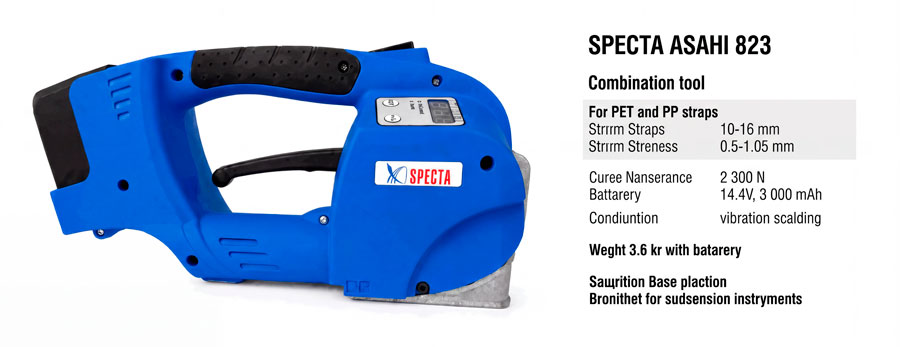
Both manual pneumatic tools and manual battery-powered tools are used for welding PET and PP strapping. SPECTA’s range includes various models that feature flexible settings and the ability to select welding modes.
In this material, we will demonstrate welding using the example of SPECTA OPTIMA PET strapping and the SPECTA ASAHI 823 manual battery-powered tool. This model is one of the most popular. The tool has a digital display for adjusting the strapping tensioning speed and welding time and is suitable for both PET and PP strapping.
Let’s look at three cases: when the strapping is over-welded, when the strapping is under-welded, and when the strapping is welded correctly.
Excessive Welding of PET Strapping
Packaging PET strapping is over-welded if the manual tool has an excessively powerful mode set for it: the welding time is set to the maximum value. In this case, the strapping will melt too much. We will see that the melt has spread far beyond the edges of the strapping.

The joint turned out weak; it will not be able to withstand a large load. It must be redone.
Now let’s look at another possible scenario.
Insufficient Welding of PET Strapping
Packaging PET strapping is under-welded when the tool has an insufficiently powerful mode set: the welding time is at the minimum or at a value insufficient for this strapping. In this case, the strapping will practically not melt. We will see that there are almost no traces of welding on it, and its edges are even.

In this case, the strapping may break at the joint. Such a joint must also be removed and redone.
Quality Welding of PET Strapping with a Manual Packaging Tool
A quality weld of PET and PP strapping should run across the entire width of the strapping and over a length of approximately 25 mm. A small amount of plastic should spread beyond the welding area. We will see it at the edges.

As can be seen in the image, with the correct welding mode, the strapping slightly protrudes beyond the edges of the joint. This is the indicator that the strapping has bonded correctly and that we have obtained a strong joint.
How to Select the Welding Mode for PET Strapping
Base it on the thickness of the strapping. Thinner strapping requires less time.
Our specialists recommend determining the optimal time experimentally. You can set an average time value and make a test joint. If the strapping is insufficiently welded, then increase the welding time. If the welding is excessive, then decrease it.
Please note: transporting cargo with incorrectly joined polyester or polypropylene strapping is strongly discouraged, because such a joint does not ensure cargo safety and can lead to injuries.
